

Hami Mahani
What to Eat After a Marathon: The First 24 Hours Refuel Plan
You crossed the finish line. Medal around your neck, foil blanket on your shoulders, and a stomach that wants absolutely nothing to do with food.
I know that feeling. And I know the mistake that follows it: skip eating, grab a shower, crash on the couch, and wake up the next day feeling like the marathon is still happening to you. What you eat and drink in the first 24 hours after 26.2 decides how the next two weeks feel.
With thousands of runners finishing in New York tomorrow, here is the refuel plan I give every runner I coach: fluids and sodium first, carbs second, protein third — in that order, on a clock.
Why the first 24 hours matter so much
A marathon empties you in three ways. Your glycogen — the stored carbs that fuel running — is nearly gone. Your muscles have real micro-damage that needs raw material to repair. And you are down several pounds of fluid and sodium, even on a cool day.
Your body is also most receptive right after the race. Muscle cells take up carbs fastest in the first few hours, and the repair crew clocks in immediately. Miss that window and you do not just feel worse tomorrow. You start the whole recovery curve a step behind — which matters when you are following a reverse taper plan back to running.
The first 30 minutes: drink before you eat
Your appetite is lying to you right now. Race effort suppresses hunger and slows your stomach down, so forcing a huge meal in the finish chute usually backfires. Fluids go down easier and matter more.
Start with 16 to 24 ounces of fluid with sodium in it — a sports drink, salted broth, or water plus something salty. Plain water alone is not enough: you lost sodium in every mile of sweat, and water without it just runs through you. I break down the actual numbers in my guide on how many electrolytes runners actually need. Personally, this is where I use HydraBlast — electrolytes I can actually get down when my stomach is still deciding whether to cooperate. Then keep sipping. The goal is steady drinking until your urine is pale yellow again, which for most runners takes most of the day.
Hours 1 to 2: the first real food — carbs lead
Once your stomach settles, eat carbs. This is the highest-leverage meal of your recovery. A good target is roughly 1 to 1.2 grams of carbohydrate per kilogram of body weight in this first feeding — for a 150-pound runner, that is about 70 to 80 grams. Think a bagel with jam, a banana, a big smoothie, chocolate milk, pretzels, a bowl of oatmeal with honey.
Keep fat and fiber modest in this meal. Both slow digestion, and your stomach has taken enough of a beating for one day. Save the giant salad and the burger for later. Right now the job is simple: refill the tank you emptied over 26.2 miles, the same tank you so carefully topped off using a fueling plan on the way in.
Hours 2 to 4: the big meal — protein joins the plate
Now eat like you mean it. This meal carries the protein: 25 to 40 grams from chicken, eggs, fish, Greek yogurt, tofu — whatever real food sounds good. Protein gives your muscles the amino acids they need to start repairing the damage, and I explain why that matters in amino acids for runners: do BCAAs actually help recovery?
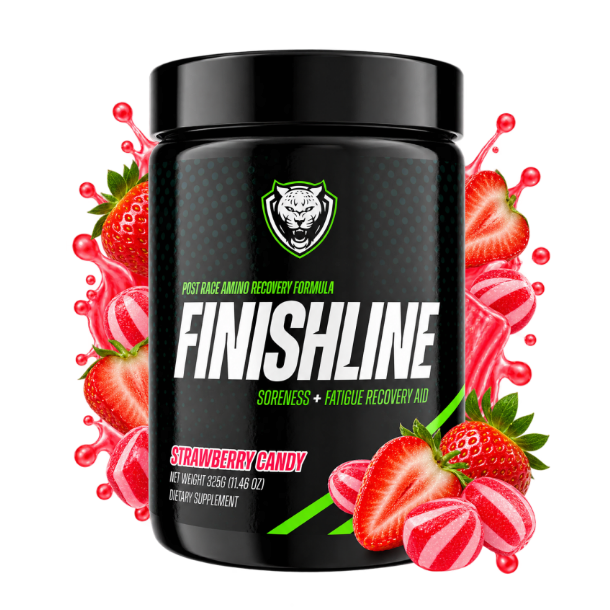
Personally, this is the window where I take FinishLine alongside the meal — I built it for exactly this job, clean recovery support on days when one more big shake is the last thing I want. Like everything we make, it is backed by our 125% money-back guarantee: if it does not help you recover to run more, you do not pay for it. A solid protein-rich meal does the foundational work either way — the point is that this meal actually happens, on purpose, not whenever you happen to get hungry.
The evening: refill like it is your job
Because today, it is. Eat a second carb-forward meal at dinner — pasta, rice bowls, potatoes — and add a snack before bed. A slow protein before sleep, like Greek yogurt or cottage cheese, gives your muscles material to work with overnight, when most repair actually happens.
Across the full first day, hard racers should aim for roughly 7 to 10 grams of carbs per kilogram of body weight. That sounds like a lot because it is. You ran a marathon. Eat like it. And keep the fluids with electrolytes going — if you are still noticeably down on the scale the next morning, you are not done rehydrating yet.
The morning after: day two starts at breakfast
Wake up and eat a real breakfast: carbs plus protein, coffee absolutely allowed. Your glycogen stores are still not full after one day, and your muscles are in their deepest repair window — day two soreness is famous for a reason.
From here, the eating gets simpler: normal meals, protein at each one, no dieting, no "making up for" the celebration food. For how the rest of the week should look — sleep, walking, and when the soreness should turn a corner — follow my hour-by-hour guide on how to recover after a marathon in your first 7 days. And when the restlessness hits and you start asking when you can run again, that is a training question, not a food one: work through the readiness checklist in my reverse taper plan for weeks 1 to 4 before you lace up.
What to skip in the first 24 hours
- The victory beer on an empty, dehydrated body: celebrate — after food and fluids, not instead of them. Alcohol before you have rehydrated just digs the hole deeper.
- Fasting because your appetite is gone: low appetite is a symptom of the effort, not a signal your body needs nothing. Eat on the clock, in small amounts if you have to.
- The giant raw salad or fiber bomb: your gut is fragile today. Cooked, simple, carb-forward food goes down and stays down. Fiber gets its moment back tomorrow.
- Starting a diet Monday morning: you cannot recover and restrict at the same time. Give it two honest weeks of eating enough first.
The short version
First 30 minutes: fluids with sodium, 16 to 24 ounces, then keep sipping all day. Hours 1 to 2: a carb-led meal, roughly 1 to 1.2 grams per kilogram. Hours 2 to 4: the big meal, with 25 to 40 grams of protein. Evening: a second carb-forward meal plus a slow protein before bed. Morning after: a real breakfast and normal eating, protein at every meal, for the full first week. You trained for months to RUN FARTHER. The runners who come back fastest treat recovery eating with the same respect — because the goal was never just to finish. It is to RECOVER TO RUN MORE.
Your turn: marathoners — what is your go-to post-race meal, the one you dream about at mile 23? Drop it in the comments. I read every one.
— Hami, 6AM Run
