

Hami
The Long Run Fueling Plan: Mile-by-Mile Nutrition for Marathon Training
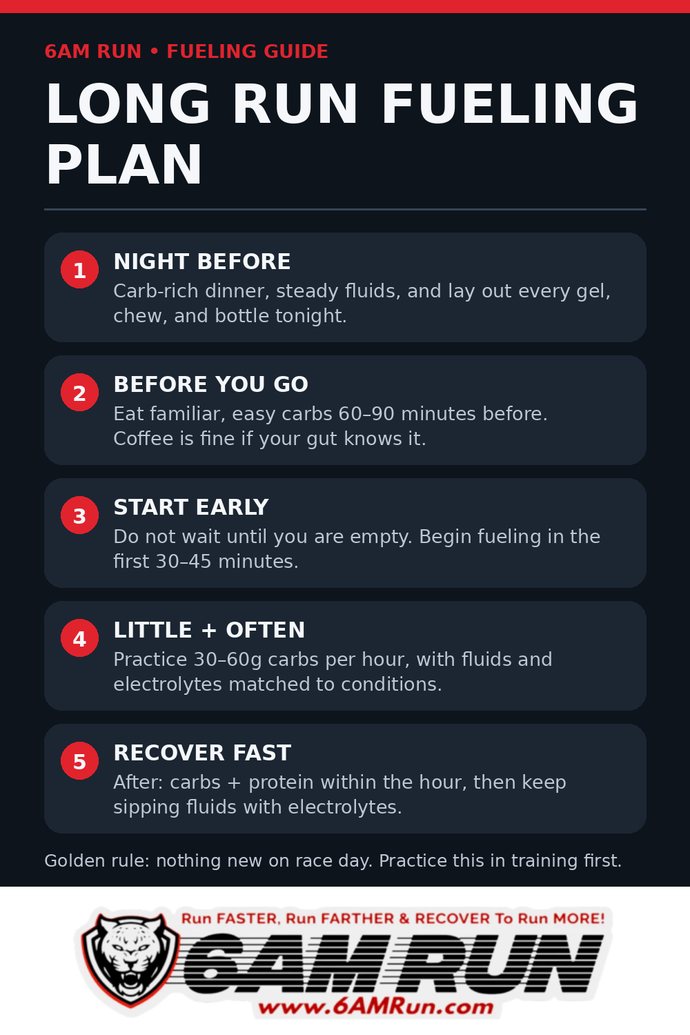
The long run fueling plan, mile by mile: night-before carbs, first fuel at 30–45 minutes, 30–60g carbs per hour, and fast recovery — the dress rehearsal for race day.
The long run is not just a longer run. It's a dress rehearsal for race day — and the runners who fuel it properly are the ones who show up to the marathon with a plan they've already proven. The runners who wing it spend the last six miles learning an expensive lesson.
I'm Hami, CEO of 6AM Run. This is the mile-by-mile fueling plan we give our runners for marathon training. It works for any long run over 90 minutes, and it scales from your first 10-miler to a 22-mile peak run.
The Night Before: Load Up and Lay It Out
Your long run starts at dinner. Eat a carb-rich meal — pasta, rice, potatoes, bread — roughly 3–4 grams of carbs per pound of body weight across the day, with steady fluids. Nothing exotic, nothing you'd be nervous to eat before a race, because that's the whole point: this is practice.
Then lay out everything tonight: every gel, chew, and bottle, counted and ready. Do the math now, not at 5:45 in the morning. For a 3-hour long run at 45g of carbs per hour, that's about 135 grams of carbs packed and waiting. Add electrolytes to at least one bottle — HYDRABLAST is our go-to for getting sodium and fluids handled before the run even starts.
Before You Go: Familiar Carbs, 60–90 Minutes Out
Eat familiar, easy carbs 60–90 minutes before you head out: 75–125 grams depending on the length of the run. Oatmeal, toast, a banana, a bagel with honey. Keep fiber and fat low — you're fueling, not digesting a project.
Coffee is fine if your gut knows it. Most of our crew runs on MARATHON before long runs — one scoop covers the pre-run energy and focus, and it's the same thing they'll use on race morning. Whatever you choose, choose the same thing every week. Routine is a fueling strategy.
Miles 1–4: Start Early, Not Empty
Do not wait until you are empty. That's the single most expensive mistake in long-run fueling, because glycogen debt compounds: every mile you run unfueled is a mile your later fuel has to rescue instead of support.
Begin fueling in the first 30–45 minutes. It feels unnecessary. Do it anyway. The first gel or serving of MARATHON 2.0 GUMMIES goes in while the run still feels easy — that's what keeps mile 16 from feeling like a wall.
Miles 5–12: Little and Often, 30–60g Per Hour
This is the engine room of the long run. Practice taking 30–60 grams of carbs per hour, in small hits every 20–30 minutes. Newer runners start at 30g; experienced marathoners training their gut can build toward 60g and beyond.
Match fluids and electrolytes to conditions: roughly 12–24 ounces of fluid per hour, more in heat, with sodium in the mix on any run over 90 minutes. Alternate fuel with sips — never take a big carb hit on a dry mouth and an empty stomach. That combo is where GI disasters are born.
Miles 13–20+: Protect the Last Third
Here's what separates a good long run from a great one: the last third should be fueled exactly like the first third. Most runners quietly stop fueling when they get tired, bored, or close to home — then wonder why the final miles always feel like survival.
Keep the schedule. Keep sipping. If your stomach turns late in the run, switch to smaller, more frequent bites rather than stopping altogether. Ten grams every 10 minutes beats zero grams and a death march. Training your gut to accept fuel at mile 18 is trainable — but only if you actually practice it.
Recover Fast: The Hour After Counts Double
After the run: carbs plus protein within the hour — 20–30 grams of protein and a real meal's worth of carbs — then keep sipping fluids with electrolytes through the day. Recovery is where the adaptation happens; the run breaks you down, the fueling builds you back.
FINISHLINE is built for this exact window, and it's part of why our runners can stack long runs week after week. If you're following a race-week plan too, our Marathon Week guide ties the whole thing together.
The Golden Rule
Nothing new on race day — and the only way to keep that promise is to practice this plan in training first. Every long run is a rehearsal: same breakfast, same timing, same fuel, same bottles. By race day, your plan shouldn't be a hope. It should be a habit.
Every 6AM Run product is backed by a 125% money-back guarantee and 50,000+ five-star reviews from runners — so test this plan on your next long run, on us. See you at 6AM.
— Hami, CEO, 6AM Run
